The AI Revolution in Programmatic Media Buying: From Simple Algorithms to Intelligent Automation
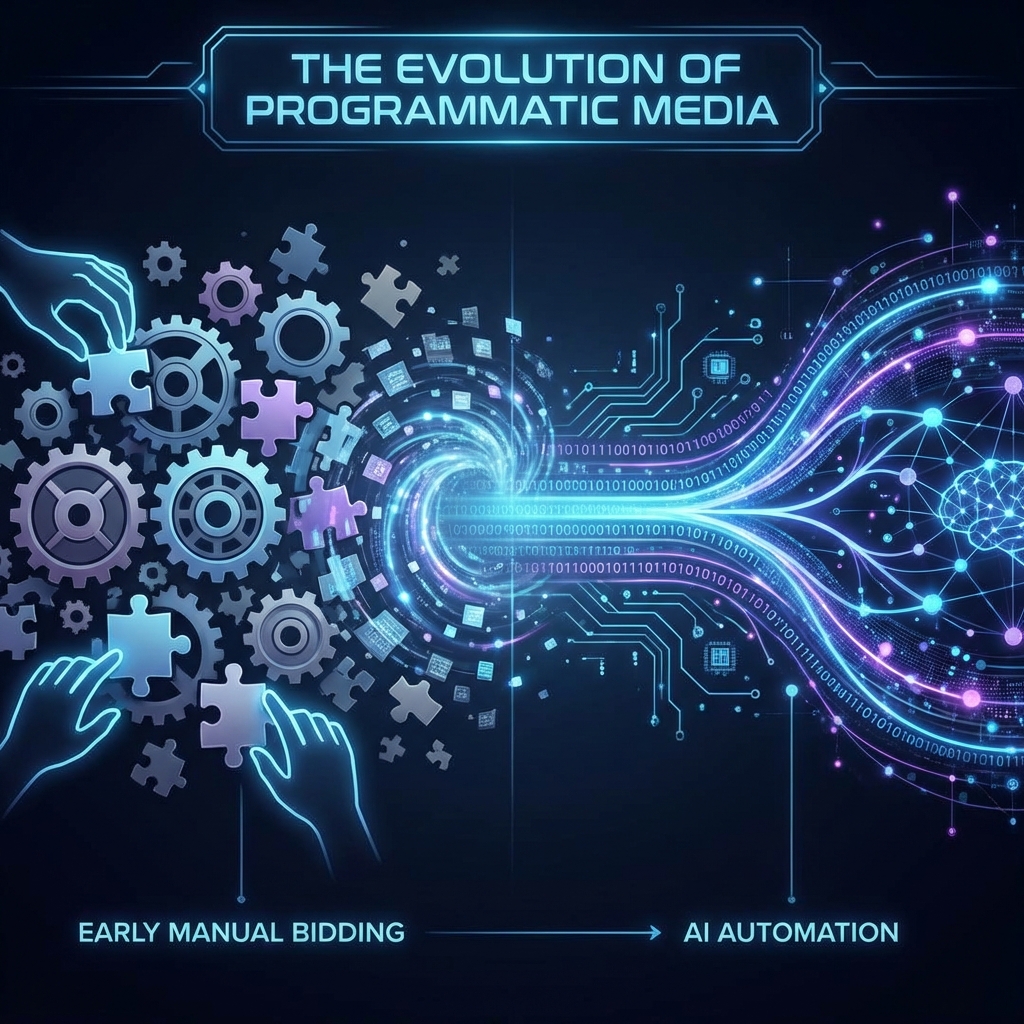
The digital advertising landscape has undergone a remarkable transformation over the past two decades. What began as manual ad placement and keyword bidding has evolved into a sophisticated ecosystem powered by artificial intelligence, fundamentally changing how brands connect with audiences.
Today’s programmatic media buying represents a quantum leap from its algorithmic origins, and understanding this evolution helps us appreciate where digital advertising is headed next.
The Dawn of Digital Advertising Automation
The story begins in the early 2000s when Google AdWords (now Google Ads) introduced the concept of paid search advertising at scale. For the first time, advertisers could bid on keywords and have their ads appear alongside search results in real-time. This was revolutionary, but the process was still largely manual. Marketing teams spent countless hours adjusting bids, testing ad copy, and analyzing spreadsheets to optimize their campaigns.
The real breakthrough came with Google’s introduction of automated bidding algorithms around 2007. These early systems used basic rules and historical data to adjust bids automatically based on factors like time of day, device type, and user location. While primitive by today’s standards, these algorithms represented the first step toward removing human intervention from routine advertising decisions.
The Rise of Programmatic and DSPs
Around 2009, the digital advertising industry experienced its next major evolution with the emergence of real-time bidding (RTB) and demand-side platforms (DSPs). Companies like MediaMath, The Trade Desk, and AppNexus pioneered technology that could evaluate and bid on individual ad impressions in the milliseconds it took for a webpage to load.
DSPs introduced a new level of sophistication to digital advertising. Instead of buying ad space in bulk or through direct negotiations with publishers, advertisers could now target specific audiences across thousands of websites simultaneously. The algorithms powering these platforms considered dozens of variables: user demographics, browsing history, geographic location, device type, and contextual relevance of the content being viewed.
The complexity was staggering. A single ad impression might trigger evaluations from dozens of advertisers, each running calculations to determine the optimal bid price based on their campaign goals and budget constraints. These platforms processed billions of such transactions daily, creating an entirely new advertising ecosystem that operated at machine speed.
The Algorithm Era: Growing Complexity
Throughout the 2010s, programmatic platforms became increasingly sophisticated. The algorithms evolved from simple rule-based systems to complex statistical models. Machine learning techniques like logistic regression and decision trees began predicting click-through rates and conversion probabilities with growing accuracy.
DSPs started incorporating lookalike modeling, which analyzed the characteristics of a brand’s best customers and found similar users across the internet. Retargeting became more nuanced, with algorithms determining not just whether to show an ad to someone who had visited a website, but when, where, and how often to do so for maximum impact.
Attribution modeling added another layer of complexity. Platforms attempted to understand the customer journey across multiple touchpoints, assigning credit to various ad exposures that led to a conversion. The mathematics behind these models grew increasingly intricate, often requiring teams of data scientists to understand and optimize.
The AI Transformation
The transition from algorithmic to AI-driven programmatic buying began gradually around 2015 but has accelerated dramatically in recent years. The key difference lies in the shift from predetermined rules and statistical models to systems that can learn, adapt, and make decisions in ways their programmers never explicitly defined.
Modern AI-powered programmatic platforms employ deep learning neural networks that can identify patterns invisible to traditional algorithms. These systems don’t just optimize for clicks or conversions; they understand context, sentiment, and user intent at a granular level. They can predict not just whether someone will click an ad, but whether they’re likely to become a long-term customer, their potential lifetime value, and even their probability of churning.
Natural language processing capabilities now allow these platforms to understand the content of web pages, videos, and social media posts at a semantic level, ensuring ads appear in truly relevant contexts while avoiding problematic content. Computer vision algorithms can analyze images and videos to understand scenes, objects, and even emotions, opening new possibilities for contextual targeting.
The Present: Fully Autonomous AI Systems
Today’s leading programmatic platforms have evolved into what can genuinely be called AI-driven systems. Google’s Performance Max campaigns, Meta’s Advantage+ shopping campaigns, and Amazon’s DSP all leverage AI that goes far beyond traditional optimization.
These platforms now handle creative generation, automatically creating and testing thousands of ad variations. They determine optimal audience segments without human input, discovering profitable micro-audiences that human marketers would never identify. Budget allocation happens dynamically across channels, formats, and audiences in real-time, responding to performance signals faster than any human could process them.
The AI systems can now predict and respond to market changes, seasonal trends, and competitive dynamics autonomously. They understand the relationship between online advertising and offline sales, incorporating weather data, economic indicators, and even social media sentiment into their decision-making processes.
Perhaps most remarkably, these AI systems have developed the ability to understand and optimize for complex business objectives beyond simple conversions. They can balance short-term performance with long-term brand building, manage portfolio-level optimization across multiple products, and even factor in inventory levels and profit margins when making bidding decisions.
Looking Ahead: The Implications of AI Dominance
The complete AI transformation of programmatic buying has profound implications for marketers. The role of media buyers and campaign managers is evolving from tactical execution to strategic oversight. Success no longer depends on mastering platform interfaces or understanding bidding algorithms, but on defining clear business objectives, ensuring data quality, and making strategic decisions about creative messaging and brand positioning.
This shift has democratized access to sophisticated advertising capabilities. Small businesses can now leverage the same AI-powered optimization as Fortune 500 companies, competing on the strength of their products and messaging rather than the size of their media teams.
However, this evolution also raises important questions about transparency, control, and accountability. As AI systems become more autonomous and their decision-making processes more opaque, marketers must grapple with how to maintain oversight and ensure their advertising aligns with brand values and regulatory requirements.
The New Reality
The transformation from simple keyword bidding to AI-orchestrated omnichannel campaigns represents one of the most dramatic technological shifts in marketing history. What once required teams of analysts, traders, and optimizers working around the clock can now be accomplished by AI systems that never sleep, never tire, and continuously learn from every interaction.
For marketers, this means focusing on what humans still do best: understanding customer needs, crafting compelling narratives, and making strategic decisions about brand positioning and business objectives. The tactical complexity that once consumed so much time and energy has been abstracted away by AI, freeing marketers to focus on creativity and strategy.
The age of truly intelligent advertising has arrived, and it’s transforming not just how we buy media, but how we think about marketing itself.