Why Your CMO Doesn't Understand Attribution (And What to Do About It)
Every quarter, the same scene plays out in conference rooms across the country. The CMO asks, “Which channel drove the most revenue?” The marketing team pulls up a multi-touch attribution model. The CMO squints at the data and says, “So… is it Google or is it Meta?”
The team tries to explain that it’s both. That the customer journey is non-linear. That first-touch and last-touch models tell different stories. That incrementality testing is more reliable than click-path attribution.
The CMO nods politely. Then makes a budget decision based on last-click.
This is a communication failure, not a data failure.
Why Attribution Is Hard to Explain
Attribution models try to answer a fundamentally impossible question: “Which marketing touchpoint caused this conversion?” The honest answer is: we can’t know with certainty. We can model probability. We can estimate influence. But causation requires controlled experiments, not click-path analysis.
The problem is that leadership doesn’t want probabilistic models. They want clear answers. “Google drove $2.3M in revenue.” Clean. Actionable. Wrong, but actionable.
The Framework That Actually Works
After years of presenting attribution data to executives, here’s the framework that consistently drives better decisions:
1. Stop Presenting Models. Present Scenarios.
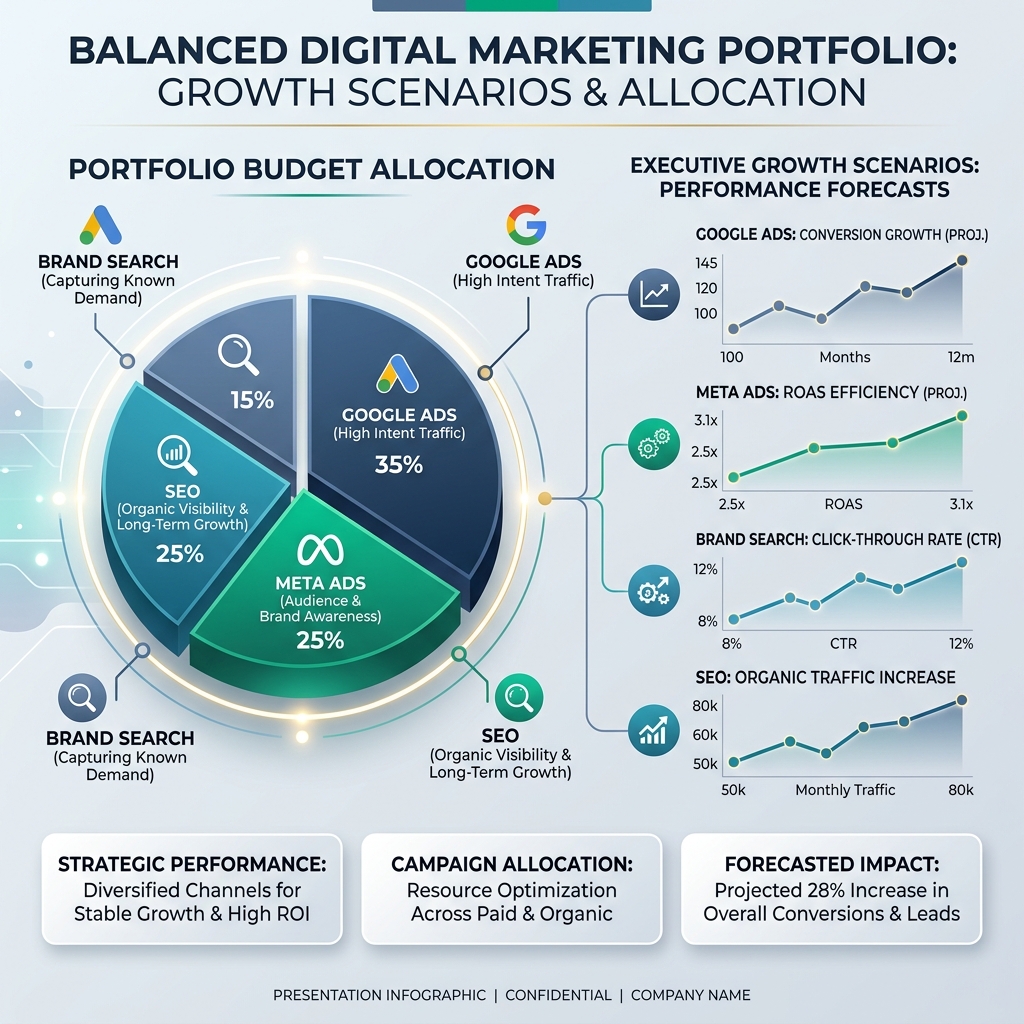
Instead of showing a multi-touch attribution report and asking leadership to interpret it, present three scenarios:
- If we increase paid search by 20%, here’s the projected impact on pipeline (based on historical conversion rates and current signal quality).
- If we cut social by 30%, here’s what we’d likely lose (based on assisted conversion data and historical A/B tests).
- If we shift 15% of Display budget to YouTube, here’s the expected tradeoff in reach vs. conversion volume.
Scenarios are actionable. Models are academic.
2. Use the Portfolio Metaphor
CMOs understand financial portfolios. They understand that diversification reduces risk. They understand that some assets are high-growth (volatile, high-upside) and some are stable (predictable, lower-ceiling).
Map your channels to a portfolio:
| Channel | Portfolio Role | Expected Behavior |
|---|---|---|
| Branded Search | Bonds | Stable, high-conversion, low growth potential |
| Non-Brand Search | Blue Chips | Reliable, scalable, moderate risk |
| PMax / AI Campaigns | Growth Stocks | High upside, requires patience, volatile early |
| Paid Social | Venture Capital | Brand-building, long payback, high strategic value |
| Display / Programmatic | Index Funds | Broad exposure, indirect returns, difficult to isolate |
When the CMO asks “Should we cut social?”, the answer becomes: “That’s like asking if we should sell all our venture investments. The short-term P&L improves, but we lose our growth pipeline.”
3. Separate Measurement from Evaluation
This is the insight that changes everything: the tool you use to measure should not be the tool you use to evaluate.
Google Analytics measures click paths. It’s a measurement tool. But the question “Is our marketing working?” is an evaluation question that requires:
- Incrementality tests: Holdout experiments that measure the lift of a channel, not just its tracked conversions.
- Marketing Mix Modeling (MMM): Statistical models that estimate channel contribution based on spend patterns and outcome correlations.
- CRM analysis: Connecting marketing touchpoints to actual revenue, not just attributed conversions.
Present measurement data for operational optimization (bid adjustments, budget pacing). Present evaluation data for strategic decisions (channel investment, program expansion/contraction).
The Real Problem
The real problem isn’t that your CMO doesn’t understand attribution. It’s that the marketing industry has spent twenty years presenting technical data to strategic decision-makers and wondering why the decisions are bad.
Translate the data into business language. Present scenarios, not models. Use metaphors they already understand.
Attribution will never be perfect. But attribution communication can be dramatically better.