Content Velocity vs. Content Authority: The AI-Era Tradeoff
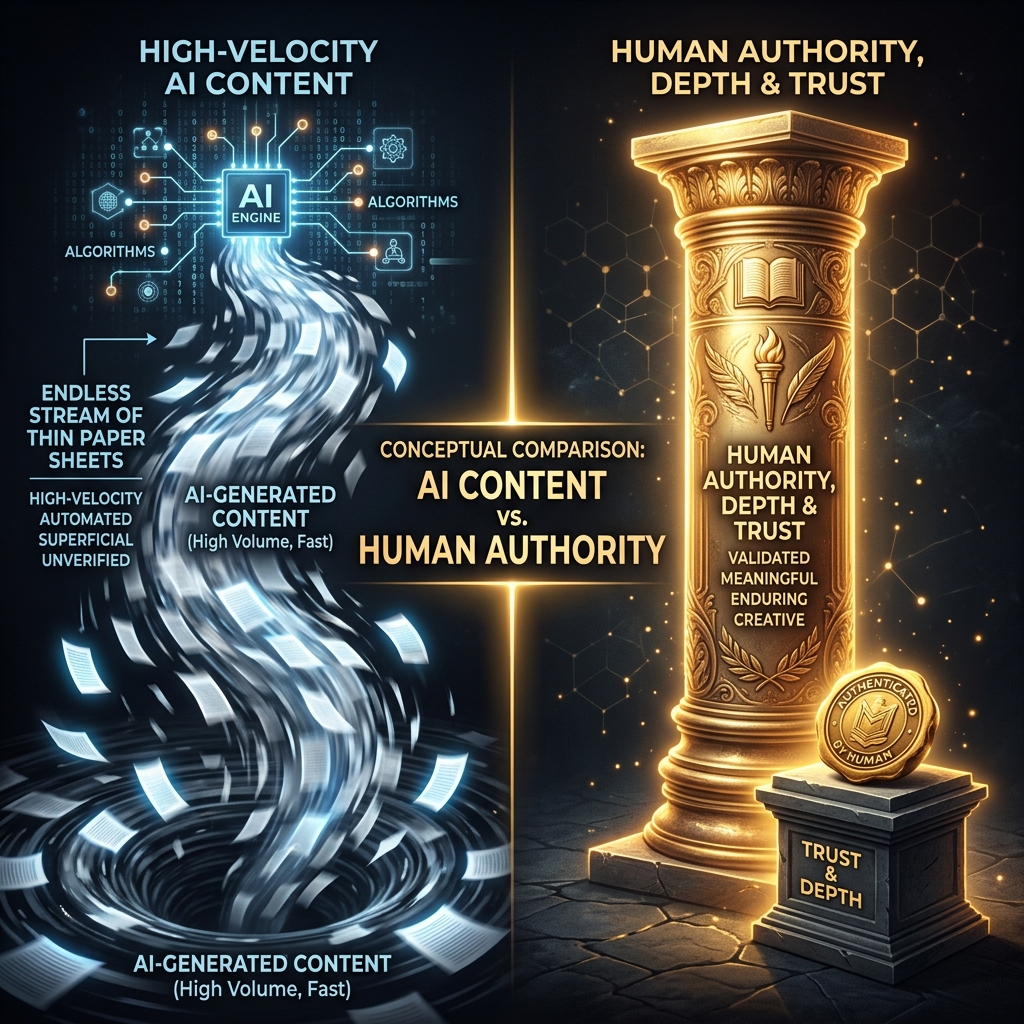
The math seems obvious. AI can generate a 1,500-word blog post in 30 seconds. Traditional content takes a human writer 4–8 hours. So the strategy must be: produce more, faster, and dominate through volume.
This is exactly what thousands of companies did in 2024 and 2025. They spun up AI content factories, published hundreds of posts per month, and watched their traffic… plateau. Then decline. Then crater.
The problem isn’t AI-generated content. The problem is the assumption that velocity equals authority.
The Velocity Trap
Content velocity—the raw output of published content—feels productive. More pages indexed. More keywords targeted. More potential entry points. It satisfies the organizational need to see “activity.”
But velocity without authority creates a specific, measurable problem: content that ranks temporarily but doesn’t stick.
Here’s the lifecycle of velocity-first content:
- Publish → 500 AI-generated posts targeting long-tail keywords
- Index → Google crawls and indexes the pages
- Rank (briefly) → Some posts appear on page 1-2 for low-competition queries
- Evaluate → Google’s quality systems assess the content
- Demote → Content lacks depth, originality, and expertise signals; rankings drop
- Dilute → The site’s overall quality score decreases, affecting all content
Step 6 is the killer. A hundred mediocre posts don’t just fail to help—they actively harm your best content by dragging down domain-level quality signals.
The Authority Approach
Content authority is the opposite strategy: fewer pieces, each designed to be the definitive resource on its topic.
An authority piece has specific properties:
- Practitioner perspective: Written by (or clearly informed by) someone who has done the work, not just researched it. First-person experience, specific numbers, named tools and frameworks.
- Structural depth: Not just “what” but “how” and “why.” Decision trees, implementation steps, troubleshooting guides.
- Citation-worthiness: Other content creators (human and AI) reference and link to it because it’s the most comprehensive and credible source.
- Update cadence: Maintained and refreshed as the topic evolves, signaling ongoing authority.
The Practitioner’s Content Mix
The optimal strategy isn’t pure velocity or pure authority. It’s a deliberate mix:
Tier 1: Pillar Content (Authority)
- Volume: 2–4 pieces per month
- Length: 2,000–4,000 words
- Purpose: Establish topical authority on your core expertise areas
- Example: “The Complete Guide to Offline Conversion Tracking in 2026”
- Maintenance: Update quarterly
Tier 2: Perspective Content (Voice)
- Volume: 4–8 pieces per month
- Length: 800–1,500 words
- Purpose: Express a point of view, build thought leadership, demonstrate expertise
- Example: “Why Your CMO Doesn’t Understand Attribution”
- Maintenance: Evergreen by nature
Tier 3: Responsive Content (Velocity)
- Volume: As needed (news cycles, industry events, algorithm updates)
- Length: 500–800 words
- Purpose: Capture trending queries, demonstrate currency
- Example: “Google’s New AI Overview Changes: What Advertisers Need to Know”
- Maintenance: Time-sensitive, naturally expires
AI is excellent for Tier 3 and can accelerate Tier 2, but Tier 1 still requires human expertise at the core. The practitioner’s role is to architect the content strategy, provide the expertise layer, and let AI handle the production efficiency.
The Measurement Shift
If you’re running a velocity strategy, you measure output: posts published, pages indexed, keyword coverage.
If you’re running an authority strategy, you measure impact:
- Backlink acquisition rate per piece
- Citation frequency in AI Overviews
- Average time on page and scroll depth
- Conversion rate per article (not per session)
- Topic authority score in your SEO platform
One pillar article that generates 50 backlinks and gets cited in AI Overviews is worth more than 500 AI-generated posts that collectively generate zero.
In the AI era, the scarcest resource isn’t content. It’s credibility.