Don't Be a User. Be a Builder!
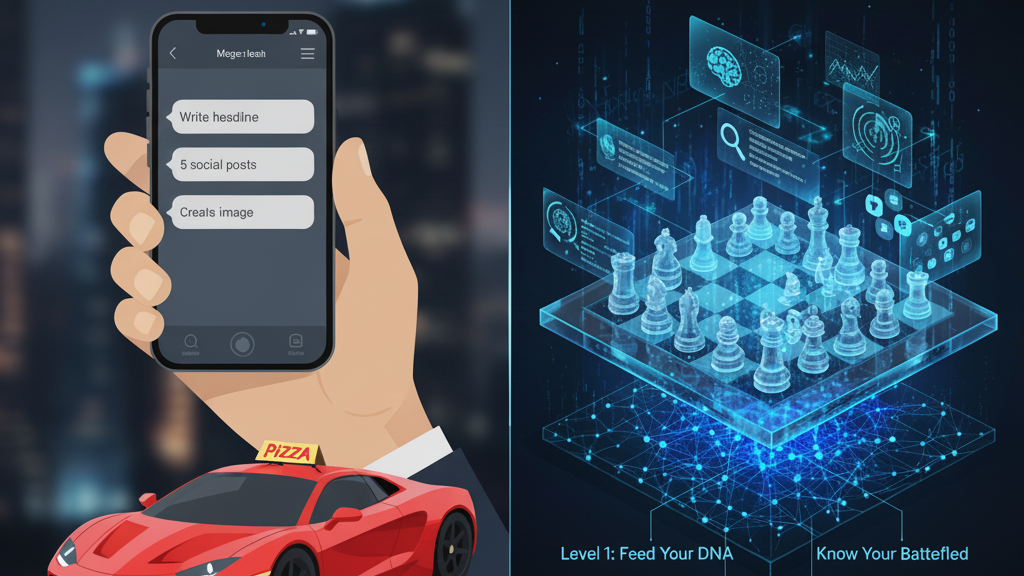
Stop Playing Small: Build an AI-Powered Marketing Brain, Not Just Another Copy Generator.
You’re using ChatGPT to write Facebook ads. Your competitor is using AI to understand their customers’ dreams, fears, and triggers and build ad copy and content around it.
Guess who’s winning?
The Surface-Level AI Trap
Here’s what 80% of marketers think “using AI” means:
- “Write me a headline for my landing page”
- “Generate 5 social media posts about our sale”
- “Create an image of a happy customer”
Congratulations. You’ve turned a revolutionary technology into a slightly faster intern. This is like buying a Super Car and driving it 35 MPH to deliver a pizza.
What Real AI-Powered Marketing Looks Like
Imagine an AI that knows:
- Every word on your website and why it’s there
- Your top 10 competitors’ messaging strategies and their weaknesses
- The exact language your best customers use in reviews
- Which emotional triggers convert browsers into buyers for YOUR specific audience
- Your brand voice so deeply it could write your autobiography
Now imagine that AI creating:
- 50 ad variations that each speak to different customer segments
- Landing pages that adapt based on traffic source
- Email sequences that feel personally written for each reader
- Social content that maintains brand consistency across every platform
- A/B tests that actually teach you something about your market
That’s not using AI. That’s building an AI-powered marketing app.
Below is an image of an AI Marketing App I created a 45 minutes ago in AIStudio Build. Its already more trained than a 2 week junior assistant. It can use Nano Banana for image creation, animate with Veo, Use Google search data, Google Maps data and generate speech… and I am just getting started.
The Intelligence Stack: How to Build Your Marketing AI Brain
Level 1: Feed It Your DNA
Start with brand foundations:
- Upload your brand guidelines, not just logos but voice, tone, values
- Feed it your best-performing content from the last 2 years
- Include customer testimonials, reviews, and success stories
- Add your founder’s story, mission, and the problem you actually solve
Level 2: Know Your Battlefield
Competitive intelligence matters: Have your AI:
- Scrape competitor websites and ads
- Analyze their customer reviews for gaps you can fill
- Map their pricing strategies and value propositions
- Note any changes or updates
Level 3: Live Data Integration
Static knowledge becomes stale fast:
- Connect your analytics to show what’s actually working
- Feed real-time customer behavior data
- Include seasonal trends and market shifts
- Update with fresh customer feedback weekly
Level 4: Multi-Channel Mastery
One brain, many voices:
- Train it on platform-specific best practices
- Teach it the difference between LinkedIn authority and TikTok authenticity
- Show it how your brand flexes across different contexts
- Build templates that maintain consistency without being robotic
The Compound Effect Nobody Talks About
Here’s what happens when you build an actual AI marketing system:
- Week 1: It writes better than your junior copywriter
- Month 1: It understands your brand better than most employees
- Month 3: It’s identifying patterns you never saw
- Month 6: It’s predicting what campaigns will work before you launch them
- Year 1: It’s a strategic partner that never sleeps, never forgets, and gets smarter every single day
But Here’s the Secret: You Have to Work ON Your AI, Not Just WITH It
Your AI isn’t a set-it-and-forget-it tool. It’s a marketing athlete that needs coaching, training, and constant challenges.
Give It New Features:
- “Now you can analyze customer support tickets for content ideas”
- “Here’s access to our CRM data find patterns in our highest-value customers”
- “You can now generate video scripts, not just written content”
Feed It New Ideas:
- “What if we targeted fear of missing out instead of desire for gain?”
- “Here’s a new framework I learned, apply it to our messaging”
- “Our competitor just pivoted, how should we respond?”
- “This campaign flopped analyze why and rebuild it”
Ask It Questions That Make You Both Smarter:
- “What patterns do you see in our highest-converting content?”
- “If you were our competitor, how would you attack our positioning?”
- “What customer objections are we not addressing?”
- “Which of our messages are actually hurting conversions?”
- “What would happen if we completely reversed our approach?”
Challenge It to Challenge You:
- “Review our last 10 campaigns and tell me what I’m missing”
- “What assumptions am I making about our audience that might be wrong?”
- “If you had to cut 50% of our marketing efforts, what would you keep and why?”
- “What are three strategies we’ve never tried that could double our conversions?”
The Difference Between Users and Builders:
AI Users: “Write me 10 headlines” AI Builders: “Based on our last 1,000 headlines, which emotional triggers consistently outperform and how can we apply them to this new product launch?”
AI Users: “Create a Facebook ad” AI Builders: “You’ve seen every ad we’ve run and every customer response design a campaign that fixes the three biggest objections causing our 67% cart abandonment rate”
AI Users: “Make this sound better” AI Builders: “You know our brand voice and our conversion data rewrite this to match what actually makes people buy, not what sounds clever”
The Real Question
While your competitors are asking AI to “write better headlines,” you could be asking:
- “What emotional framework would resonate with customers who abandoned their cart in the last 30 days?”
- “How should we adjust our messaging for the demographic shift we’re seeing in our analytics?”
- “What content strategy would position us as the obvious choice against our top three competitors?”
Your Move
Tomorrow, you’ll either:
- Ask AI to write another generic blog post, or
- Start building an AI that knows your business better than you do and have it write all of your blog post and… your social media post, your website pages, your google ad copy, your video content (in every format), your Press Releases and anything else you can think of.
The choice is yours. But remember: In the age of AI, the companies that win won’t be the ones using AI tools. They’ll be the ones building AI-powered systems.
The surface-level users are playing checkers. The system builders are playing 3D chess. Which game are you playing?