The Google Ads Paradigm Shift: Feed, Signal, Steer
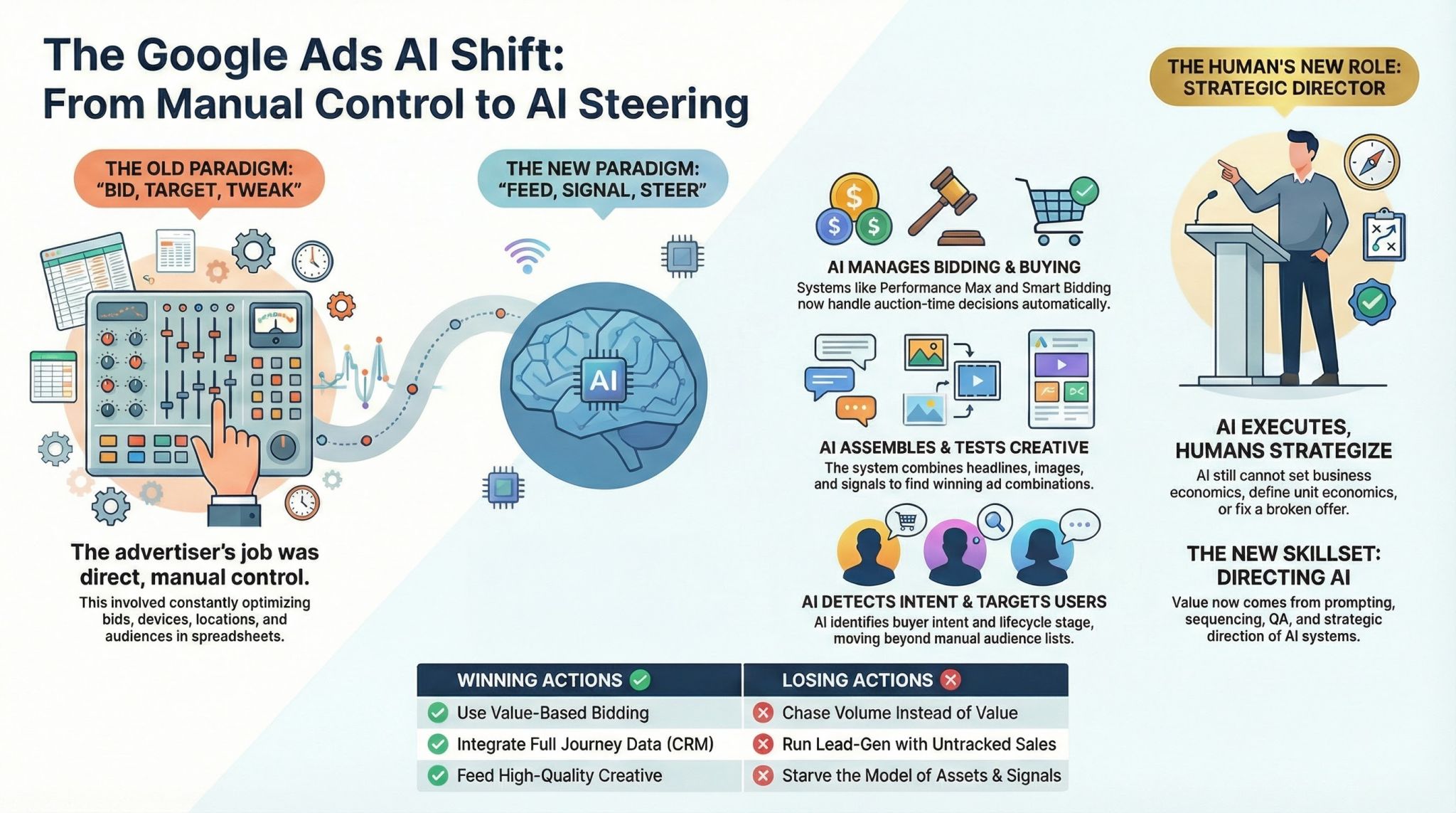
The operational paradigm for Google Ads has fundamentally shifted from a model of manual control to one of AI-driven automation. This transformation reflects a broader industry trend where specialized marketing roles are consolidating into a single, AI-augmented operator responsible for strategic direction rather than tactical execution.
The Evolution of Control
The core principle of managing Google Ads is no longer “Bid, target, tweak,” but has evolved into a new mandate: “Feed, signal, steer.”
1. Feed: High-Quality Data
Success in this new environment depends on an advertiser’s ability to provide the platform’s machine learning models with high-quality data. This means ensuring your conversion tracking is robust, your first-party data is integrated, and your product feeds are rich with attributes. The algorithm is hungry for context; the better you feed it, the better it performs.
2. Signal: Creative Assets
Creative is the new targeting. In a world of broad match and Performance Max, your creative assets—headlines, descriptions, images, and videos—act as the primary signals for finding your audience. Diverse, high-quality creative assets allow Google’s AI to match the right message to the right user at the right time.
3. Steer: Business Objectives
Your role is to set the destination. Instead of micromanaging CPCs, you must steer the AI with clear business objectives (ROAS, CPA, Profitability) and sophisticated value-based bidding strategies. You are the pilot; the AI is the engine.
The AI-Augmented Operator
This shift requires a new breed of marketer: the AI-augmented operator. This professional understands how the black box works not by trying to dismantle it, but by mastering the inputs and outputs. They focus on strategy, creative storytelling, and business alignment, leaving the calculation and real-time auction dynamics to the machine.