Building a Marketing Brain: My Personal AI Operating System
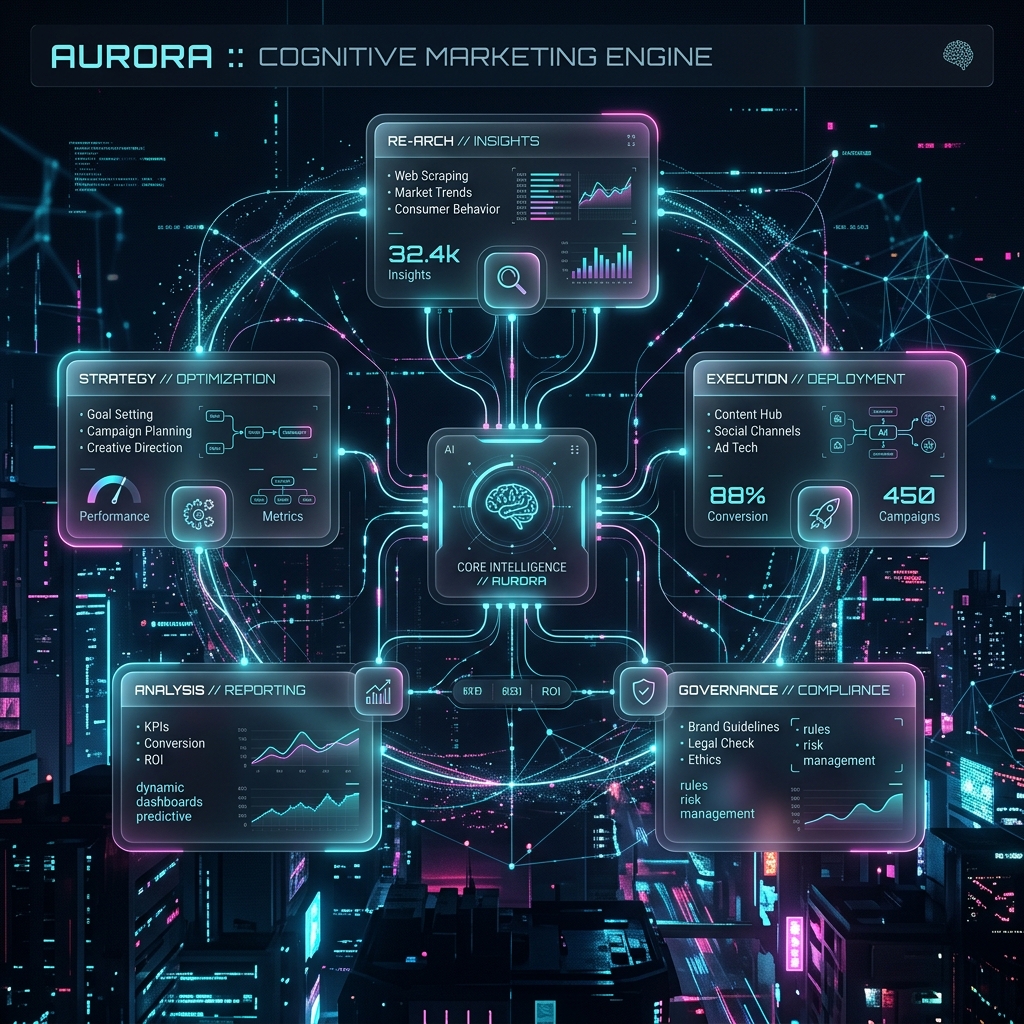
Most marketers use AI the way most people use a Swiss Army knife: they pull out one tool at a time, use it for a single task, and put it back. A headline here. A summary there. Maybe a research query when they’re stuck.
I operate differently. Over the past two years, I’ve built what I call a Marketing Brain—an interconnected system of specialized AI agents, each with a defined role, clear inputs and outputs, and governance protocols that prevent the system from hallucinating its way into bad decisions.
This isn’t theoretical. This is the system I use daily to manage campaigns, generate strategy, analyze performance, and create content.
The Architecture
The Marketing Brain has five layers:
Layer 1: The Research Engine
Purpose: Continuous market intelligence gathering and synthesis.
This layer monitors competitor activity, industry news, algorithm changes, and audience behavior signals. It doesn’t just collect information—it synthesizes it into actionable briefings.
Key agents:
- Competitive Monitor: Tracks competitor ad copy changes, landing page updates, and estimated spend shifts
- Algorithm Watcher: Parses Google/Meta/Microsoft changelog and translates updates into tactical implications
- Audience Listener: Analyzes search trend data, social mentions, and review sentiment for emerging patterns
Output: A weekly “Intelligence Briefing” that surfaces the 3–5 most actionable insights.
Layer 2: The Strategy Layer
Purpose: Transform intelligence into strategic recommendations.
This is where raw data becomes directional advice. The strategy agents don’t make decisions—they present options with trade-off analysis.
Key agents:
- Budget Allocator: Given performance data and goals, recommends budget shifts across channels with projected impact ranges
- Audience Architect: Builds and refines audience segment hypotheses based on conversion data and behavioral signals
- Message Strategist: Maps audience pain points to value propositions and recommends creative angles
Output: Strategic recommendations with confidence intervals and risk assessments.
Layer 3: The Execution Engine
Purpose: Transform strategy into campaign assets and configurations.
This is the production layer where AI shows its highest ROI. Tasks that used to take hours happen in minutes.
Key agents:
- Copy Generator: Produces ad copy, landing page content, and email sequences aligned with strategic briefs
- Asset Coordinator: Generates creative briefs, suggests image concepts, and assembles asset libraries for PMax campaigns
- Campaign Builder: Translates strategic recommendations into campaign structures, targeting configurations, and bid strategies
Output: Campaign-ready assets and configurations.
Layer 4: The Analysis Engine
Purpose: Continuous performance monitoring and diagnostic analysis.
Key agents:
- Performance Analyst: Daily performance synthesis with anomaly detection and root-cause hypotheses
- Quality Auditor: Cross-references platform metrics with CRM data to assess true conversion quality
- Attribution Modeler: Runs incrementality estimates and cross-channel influence analysis
Output: Performance reports with diagnostic insights and recommended actions.
Layer 5: The Governance Layer
Purpose: Quality control, fact-checking, and decision validation.
This is the most critical layer—and the one most AI systems lack. Every output from Layers 1–4 passes through governance before it reaches a human decision-maker.
Key functions:
- Fact Verification: Cross-references AI-generated claims against verified data sources
- Bias Detection: Flags when recommendations over-index on recent data or ignore known seasonality patterns
- Consistency Check: Ensures recommendations align with established brand guidelines and compliance requirements
The Governance Principle
Here’s what separates a Marketing Brain from a collection of AI tools: the human is the governor, not the operator.
In a traditional workflow, the human does the work and occasionally uses AI for assistance. In my system, the AI does the work and the human validates, directs, and decides.
This isn’t about removing humans from the process. It’s about elevating the human role from execution to judgment. The AI handles the cognitive labor of research, synthesis, and production. The human handles the strategic judgment of “Is this the right thing to do?”
The Daily Workflow
Here’s what a typical day looks like:
7:00 AM — Review the Intelligence Briefing (Layer 1 output). Flag any items that need deeper analysis.
8:00 AM — Review overnight performance reports (Layer 4 output). Approve or redirect recommended optimizations.
9:00 AM — Strategic session: review budget allocation recommendations and audience segment performance. Make weekly adjustment decisions.
10:00 AM – 12:00 PM — Creative production: review and refine AI-generated copy and assets. Provide feedback that improves future outputs.
1:00 PM — Governance review: spot-check AI outputs from the morning against source data and brand guidelines.
2:00 PM onward — Human-only work: client communication, team leadership, strategic planning, relationship building.
Notice the pattern: AI handles the morning. Humans handle the afternoon. The work that requires empathy, judgment, and relationship—the work machines can’t do—gets the human’s best energy.
Building Your Own
You don’t need to build all five layers at once. Start with one:
- Pick your biggest time sink. Where do you spend the most hours on repetitive cognitive work?
- Build one agent for that task. Define its role, inputs, outputs, and quality criteria.
- Run it in parallel. Let the agent work alongside your manual process for two weeks. Compare outputs.
- Refine and trust. Adjust the agent based on quality gaps, then gradually delegate.
- Expand. Add the next agent, then the next, until you have a system.
The future of marketing leadership isn’t “using AI.” It’s operating an AI system.