Think in Patterns: The Question Journey
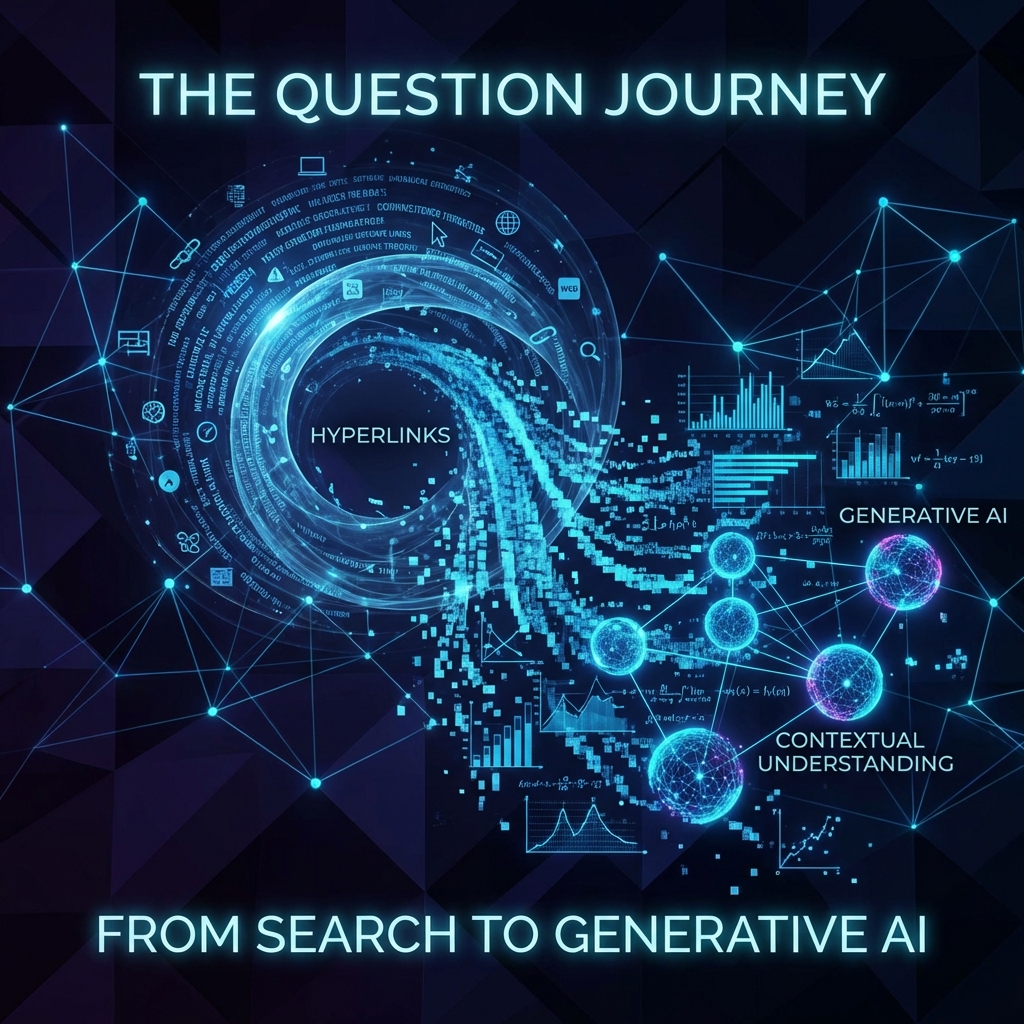
The most profound shift in modern marketing isn’t just that we’ve moved from keywords to questions, it’s that we’ve entered an era where the answers themselves have become invisible.
When customers get responses from ChatGPT, Claude, or Gemini, they’re often not clicking through ten blue links anymore. They’re getting synthesized answers from patterns in trained data, sometimes with citations, often without. Just an answer that emerged from the mathematical AI void.
This is the new reality of the Question Journey: a customer path increasingly mediated by AI, where your carefully crafted content might be absorbed into patterns and regenerated without clear attribution.
The Technical Reality: How GPT Architecture Reshapes Marketing
To understand why AI created this attribution challenge, you need to understand what GPT actually means: Generative Pre-trained Transformer. Each word explains why your marketing metrics are evolving:
- Generative: These models don’t just retrieve information - they generate new text based on probability distributions. Your content isn’t being “found” and “displayed” - it’s being dissolved into statistical relationships and regenerated as something new.
- Pre-trained: The model learned from hundreds of billions of tokens (trillions of words) before your customer ever asked their question. If your site was publicly crawlable before 2023, your content might be in that training data, influencing answers about your industry - though there’s no way to confirm.
- Transformer: This architecture excels at modeling contextual relationships between tokens, allowing it to synthesize information from countless sources into seamless, authoritative-sounding answers. The loss of attribution isn’t deliberate - it’s an artifact of how the architecture works.
This is why GPT-based systems fundamentally challenge traditional marketing: they’re not search engines that retrieve and cite - they’re pattern machines that absorb and regenerate.
Why Attribution Becomes Complex (And Why It Matters)
The “Pre-trained” nature of these models creates big-time attribution challenges:
- Training Data Uncertainty: If your site was publicly accessible before 2023, it could be in GPT-4’s training. Or not. There’s no confirmation either way.
- Temporal Mismatch: Most current models were trained before late 2023. Your recent content literally doesn’t exist in their pre-trained knowledge. (But Not Grok).
- Statistical Dissolution: Even if your content was included, it’s now stored as statistical relationships between tokens, not as retrievable text.
The Attribution Challenge:
- For pre-trained knowledge: Attribution is architecturally impossible
- For retrieval-augmented generation: Attribution is partial and inconsistent
- For your latest content: It might not exist in the AI’s world at all
Yet this isn’t the death of marketing, it never is, it’s an evolution. When traditional attribution breaks down, new opportunities emerge. More is being tracked now than ever before.
Think in patterns, think in history.